Barrier Screws with a Maddock Zone
21 Mar 2025Know-How
EXTRUSION: Barrier Screws and Mixers
For some reason, there are many barrier screws running with high-shear mixers, when a distributive mixer is generally the better choice.
There are many types of mixing devices used on single-screw extruders. They differ in being either mainly dispersive devices, or shearing devices that add polymer melting capacity, or redistributive devices that mix essentially by splitting the melt many times in order to distribute the minor
component as layers throughout the main component. All mixers necessarily have some of these features.
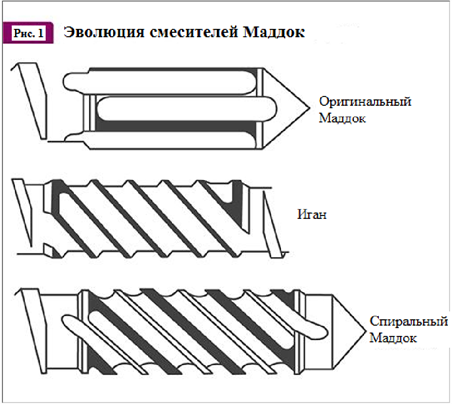
Newer Maddock-type mixers have features of both the original Maddock and Egan designs. The shaded areas are undercut or clearance areas through which the polymer must pass and receive aggressive shear.
Distributive mixers are generally the better choice for barrier screws. Each of these common designs has its own advantages and disadvantages.
The use of these mixing devices affects overall screw performance. Cross-channel mixers, the most common of which are referred to as Egan and LeRoy mixers, date back to the late 1960s. The LeRoy mixer is better known as the Maddock or UCC mixer, after the work of extrusion legend Bruce Maddock at Union Carbide Corp.
Later, the Maddock spiral mixer was developed, which combines features of both designs and appears to be the most widely used today (Fig. 1). A good deal has already been written about these mixers, so there is no need to describe them here again.
Egan and Maddock mixers were originally developed to improve the melt quality of conventional (non-barrier) screws. They have been used to process many different polymers in various applications, but found their real value in processing crystalline polymers, mainly polyolefins. They gained almost immediate acceptance in the market because they significantly improved both output and melt quality.
In 1961, before these mixing sections were put into service, a barrier screw design for processing rubber was developed by Geyer at Uniroyal. Soon afterwards, attempts were made to apply his melt/solid separation concept to processing thermoplastic polymers, and within about 10 years the barrier screw reached its present position on the market. Barrier screws eliminate the need for additional mixers, since melting can be controlled and completed in the barrier section, without the need for high-shear mixers.
Nevertheless, even today quite a few barrier screws are equipped with high-shear mixers, although the need for them has in theory been eliminated from barrier screws. I find this puzzling.
With a correct design, once the material has passed through the barrier section in these screws, it should be fully molten. In most cases, adding a dispersive or shear mixer after the barrier section leads to an unnecessary rise in melt temperature, reduces output due to the added pressure drop, and results in higher energy consumption, both in the extrusion process and in subsequent cooling processes. Most of the time a distributive mixer would be the better choice for homogenizing temperature, color or additive distribution, while providing minimal additional melt temperature rise and output reduction.
There are many types of distributive mixers, and the choice depends on the
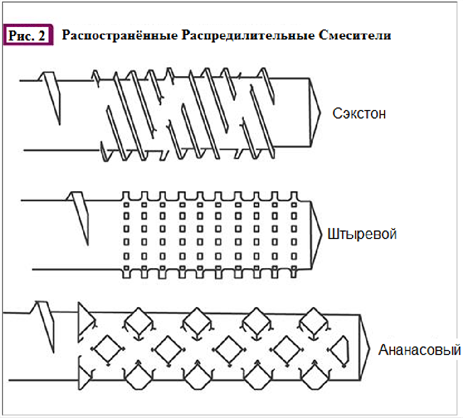
properties of what is to be mixed, the proportion of each component, and the L/D of the screw. Some of the most common distributive mixers are shown in Fig. 2.
The Saxton style provides mixing by dividing the melt into several channels, while the interrupted flight width provides mixing between these channels. In principle, however, this design relies on the same mixing principles as the metering section, and is most effective primarily for thermal homogenization. The advantage of the Saxton may be that it is designed for a very low pressure drop.
Pin mixers can split the melt many times, creating essentially exponential divisions based on the number of pins and rows. Mixers of this type minimize the limitations of laminar flow mixing, and can mix materials of substantially different viscosity, creating an infinite number of layers. Their drawback is that they can create a significant pressure drop.
Pineapple mixers divide the melt like pin mixers, but recombine the divisions at different angles for chaotic mixing. They are very useful when adding color.
Regardless of the mixer type chosen, distributive types appear to suit the needs of barrier screws better than shear-type dispersive mixers, except where there is a specific requirement for intensive shearing of particles small enough to pass through the barrier section unbroken. Screw and barrel wear is a serious issue for maintenance and engineering departments in both extrusion and injection molding, and for good reason. Excessive wear in a plasticating unit brings a long list of problems with inconsistent output (throughput), which directly affect the cost and overall quality of the product being made. In an article in the February 2018 issue of Plastics Technology, asking "What Is Your Extruder Trying to Tell You?", the authors Wes Hobson and Mike Rutkowski of The Dow Chemical Company demonstrated the need for baseline data and wear monitoring in order to avoid excessive loss of output.